
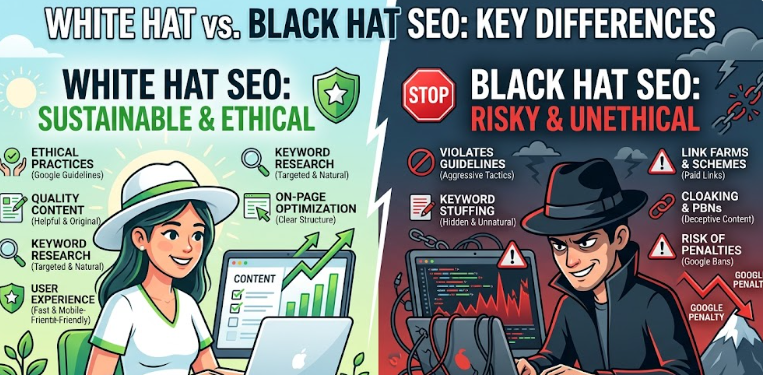
If you are learning digital marketing or search engine optimization (SEO), you have probably come across two terms again and again: Black Hat SEO and White Hat SEO. These two terms describe two completely different ways of ranking a website on Google and other search engines.
One method is safe, honest, and long-lasting. The other is risky, fast, but dangerous. In this article, we will break down both concepts in simple English so that students and beginners can understand them without confusion.
What is SEO?
Before understanding Black Hat and White Hat SEO, let’s quickly recall what SEO means. SEO stands for Search Engine Optimization. It is the process of improving a website so that it ranks higher in search engine results pages (SERPs) for relevant keywords, bringing more organic traffic (free, unpaid visitors) to the site.
Now, there are two major “paths” people take to achieve this ranking — one following the rules, and one breaking them.
What is White Hat SEO?
White Hat SEO refers to ethical, rule-following SEO techniques that follow the official guidelines set by search engines like Google, Bing, and Yahoo. This approach focuses on creating genuine value for users rather than trying to trick the search engine algorithm.
Key Features of White Hat SEO
- User-first approach: Content is created for real human readers, not just search engine bots.
- Quality content creation: Writing original, well-researched, and helpful articles or blog posts.
- Proper keyword research: Using keywords naturally instead of stuffing them everywhere.
- Mobile-friendly design: Making sure the website works well on phones and tablets.
- Fast loading speed: Optimizing images and code so pages load quickly.
- Ethical link building: Earning backlinks from trustworthy and relevant websites through guest posting, partnerships, or high-quality content.
- Clear site structure: Using proper headings, meta tags, and easy navigation.
- Following EEAT principles: Demonstrating Experience, Expertise, Authoritativeness, and Trustworthiness in content.
Benefits of White Hat SEO
- Builds long-term, sustainable rankings
- Improves brand reputation and trust
- Reduces risk of penalties from Google updates
- Creates a better experience for website visitors
- Supports steady, organic growth over time
White Hat SEO takes time and patience. It is not a quick fix, but it protects your website from being banned or penalized by search engines.
What is Black Hat SEO?
Black Hat SEO refers to techniques that violate search engine guidelines. These methods try to manipulate search engine algorithms to gain fast rankings, without focusing on real user value. Although Black Hat SEO can sometimes bring quick results, it is extremely risky and can get a website banned or deindexed permanently.
Common Black Hat SEO Techniques
- Keyword stuffing: Repeating the same keyword unnaturally many times in the content.
- Cloaking: Showing different content to search engine crawlers than what real users see. Google’s crawler now renders pages visually, so this mismatch is detected more easily than before.
- Hidden text and links: Placing invisible text (such as white text on a white background) filled with keywords.
- Link spam and link schemes: Buying, selling, or exchanging links mainly to manipulate a page’s ranking rather than to help users.
- Scraped or duplicate content: Copying content from other websites without adding original value.
- Doorway abuse: Creating multiple similar low-quality pages, each targeting a slightly different search query, that lead users to intermediate pages instead of the most useful destination.
- Expired domain abuse: Buying an old, expired domain purely to reuse its existing authority and backlinks for unrelated content.
- Site reputation abuse (also called parasite SEO): Publishing unrelated or low-value third-party content on a trusted, high-authority website just to borrow its ranking power.
- Scaled content abuse: Mass-producing thin, templated, or AI-generated pages with little original value, created mainly to rank rather than to genuinely help readers.
Risks of Black Hat SEO
- Search engines like Google can remove pages, demote rankings, or deindex a website entirely
- Sudden ranking drops during regular spam and quality updates, which Google now rolls out very frequently throughout the year
- Damaged brand reputation among users if manipulative tactics are exposed
- Wasted time and money once a site is penalized and has to be rebuilt
- Loss of trust from both search engines and real visitors
Google’s automated spam-detection system, known as SpamBrain, works alongside regular core and spam updates to identify manipulative patterns, including AI-generated spam and abused expired domains. Many beginners get attracted to Black Hat SEO because it promises fast results. However, professional SEO experts avoid it because the risks are far greater than the short-term benefits, and detection has become faster and more accurate over time.
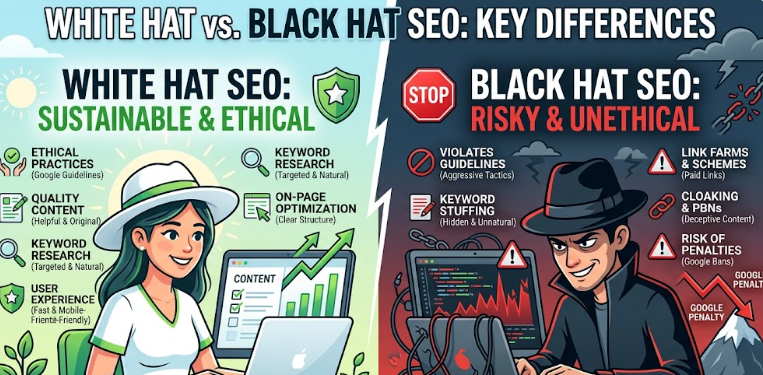
White Hat vs Black Hat SEO: Key Differences
| Aspect | White Hat SEO | Black Hat SEO |
|---|---|---|
| Approach | Follows search engine guidelines | Breaks search engine rules |
| Focus | Real user experience | Tricking algorithms |
| Speed of results | Slow but stable | Fast but temporary |
| Risk level | Low | Very high |
| Longevity | Long-term success | Short-term, risky |
| Content quality | High and original | Often duplicate or spammy |
Is There a “Grey Hat SEO”?
Yes — there is also something called Grey Hat SEO. This sits between the two extremes. It includes borderline techniques, such as paying for “niche edits” (getting links inserted into already-published articles) or using AI writing tools without proper human editing and fact-checking. These tactics are not always treated the same way by Google, and a technique considered low-risk today can be reclassified as spam after a future update. Grey Hat SEO carries real risk and should be approached carefully.
Why Google Prefers White Hat SEO
Google’s main goal is to give users the best, most relevant, and trustworthy answers to their search queries. This is why Google’s algorithm updates constantly target Black Hat techniques. Concepts like EEAT (Experience, Expertise, Authoritativeness, Trustworthiness) were introduced specifically to reward websites that provide genuine value.
Search engines use complex signals, including:
- Natural language processing (NLP) to understand content meaning, not just keywords
- User engagement metrics like time on page and bounce rate
- Backlink quality and relevance
- Content originality and depth
All these signals favor White Hat practices and penalize manipulative tactics.
How Students Can Learn Ethical SEO
If you are a student who wants to build a career in digital marketing, here are some practical tips:
- Start by learning basic on-page SEO (titles, meta descriptions, headings)
- Practice writing original, informative content on topics you understand well
- Learn keyword research tools like Google Keyword Planner or Ubersuggest
- Study technical SEO basics such as site speed and mobile optimization
- Understand off-page SEO through ethical link-building strategies
- Follow official Google Search Central documentation for updated guidelines
- Avoid shortcuts — focus on building skills, not just quick rankings
For the most accurate and up-to-date rules, always check Google’s own Spam Policies for Google Web Search page under Google Search Central. Search engine rules change often, and official documentation is more reliable than second-hand blog opinions, including this one.
Frequently Asked Questions (Q&A)
Q1: Which is better, White Hat or Black Hat SEO? White Hat SEO is always better for long-term success. Black Hat SEO may give quick results, but it puts the website at high risk of penalties or bans.
Q2: Can Black Hat SEO get a website banned permanently? Yes, search engines like Google can completely deindex a website if they detect serious Black Hat violations, meaning the site disappears from search results.
Q3: Is keyword stuffing considered Black Hat SEO? Yes, keyword stuffing is one of the most common Black Hat techniques. Modern search engines can easily detect unnatural keyword repetition.
Q4: How long does White Hat SEO take to show results? White Hat SEO usually takes a few months to show noticeable results, but the rankings tend to be more stable and long-lasting.
Q5: What is Grey Hat SEO? Grey Hat SEO includes techniques that are not officially banned but are also not fully recommended, sitting between ethical and manipulative practices.
Q6: Do beginners need to learn technical SEO too? Yes, understanding basic technical SEO — like site speed, mobile-friendliness, and proper indexing — is essential alongside content-focused SEO skills.
Final Thoughts
Understanding the difference between Black Hat and White Hat SEO is one of the most important lessons for anyone entering the field of digital marketing. While Black Hat SEO might look tempting because of its quick results, it almost always leads to long-term damage. White Hat SEO, on the other hand, builds a strong, trustworthy, and sustainable online presence.
For students and beginners, the best path forward is simple: focus on creating real value for users, follow search engine guidelines honestly, and be patient. Ethical SEO practices not only protect your website but also build genuine trust with your audience — and that trust is something no shortcut can buy.
Leave a Reply