
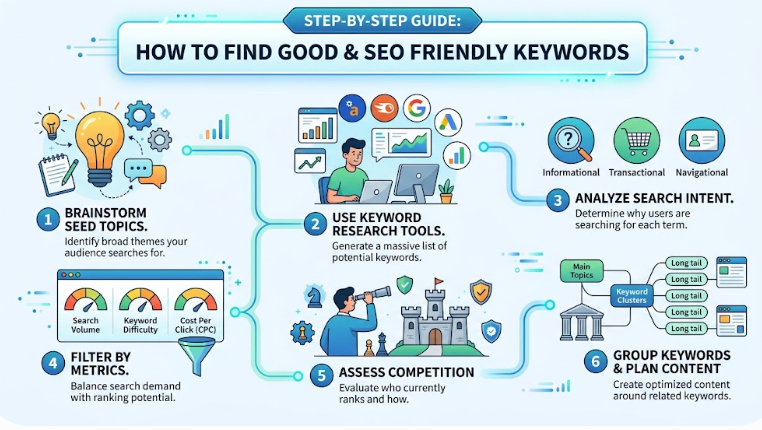
Finding the right keywords is the foundation of any successful Search Engine Optimization (SEO) strategy. If you target terms that are either too competitive or completely ignored by searchers, your content will fail to rank or generate meaningful traffic. A solid keyword research strategy balances search volume, intent, and competitive difficulty to ensure your site gains authority and visibility.
Core Pillars of Effective Keyword Research
To rank high on modern search engines, keyword selection must align with search intent, topical relevance, and target audience needs.
- Understand Search Intent: Always align content with what the user wants to accomplish—whether it is Informational (how-to), Navigational (brand searches), Commercial (pre-purchase research), or Transactional (ready to buy).
- Evaluate Keyword Metrics: Balance Monthly Search Volume (MSV) with Keyword Difficulty (KD). Target low-to-medium difficulty terms when building initial site authority.
- Analyze Search Engine Results Pages (SERPs): Inspect top-ranking pages to identify what formats (guides, tools, lists) Google prefers for your chosen term.
- Identify Content Gaps: Uncover missing angles, outdated statistics, or unanswered questions in top-ranking articles to offer superior value.
- Integrate E-E-A-T: Demonstrate Experience, Expertise, Authoritativeness, and Trustworthiness by adding real-world insights, original data, and practical steps.
Step 1: Define Your Core Topics and Seed Terms
Before using advanced tools, list the broad topics your website covers. Seed keywords serve as the starting point to discover hundreds of related search queries.
- Brainstorm pain points and common questions your target audience asks.
- Group topics into logical categories to establish a clear site architecture.
- Examine industry forums, Q&A sites, and social media discussions for authentic user phrasing.
Step 2: Generate and Filter Semantic Keyword Variations
Instead of focusing solely on single target phrases, modern SEO relies on semantic search—understanding the contextual relationship between terms. Search engines use algorithms to rank pages that cover a topic comprehensively rather than those that repeat exact words.
When analyzing specific niches, integrating brand or product terms naturally demonstrates how seed terms translate into real-world search queries:
- Analyzing Niche Queries: For instance, if you run a digital publication covering oral care trends, optimizing an article around a brand query like brasssmile requires placing it in contexts where users look for product reviews, material safety, or aesthetic outcomes.
- Addressing Functional/Operational Topics: Similarly, if you manage an administrative portal or workforce platform, addressing specific operational searches like the uge schedule source helps satisfy exact user queries regarding login procedures, shift tracking, and schedule updates.
Using long-tail contextual variations ensures that search engines recognize your depth of knowledge without resorting to repetitive keyword patterns.
Step 3: Analyze Search Intent and SERP Features
Keyword volume alone does not guarantee traffic. You must verify whether your proposed page format matches SERP expectations.
| Search Intent | User Goal | Ideal Content Format | Example SERP Features |
| Informational | Learn about a topic | How-to guide, blog post, wiki | Featured Snippets, People Also Ask |
| Commercial | Compare options | Best-of list, comparison table | Product reviews, star ratings |
| Transactional | Make a purchase | Product page, landing page | Shopping ads, store listings |
| Navigational | Find a specific site | Brand homepage, login page | Site links, knowledge panel |
- If the top 10 results for a keyword are all interactive tools or calculators, publishing a standard blog post will rarely rank.
- If SERPs show “People Also Ask” accordions, answer those specific queries directly in your headings and short body paragraphs.
Step 4: Execute Content Gap Analysis
Content gaps represent opportunities where competitors fail to provide complete answers. Finding and filling these gaps is essential to outranking established sites.
- Map Competitor Headers: Scrape the H2 and H3 tags of the top three ranking pages for your primary keyword.
- Identify Omissions: Spot missing steps, outdated instructions, or unaddressed edge cases.
- Enhance Depth with Semantic Terms: Incorporate related secondary terms naturally. For example, in consumer product guides, mentioning brands like brasssmile alongside terms like alignment options, durability, or maintenance tips fills valuable information gaps.
- Provide Actionable Resources: In administrative or operational guides, referencing specific tools like the uge schedule source alongside queries about shift management, portal access, or employee timetables ensures the content thoroughly answers user intent.
Step 5: Natural Keyword Placement and Formatting
To avoid keyword stuffing while maximizing search relevance, place your primary and secondary terms strategically throughout the document:
- URL Slug: Keep it short, clean, and inclusive of the main target phrase (e.g.,
/how-to-find-seo-keywords). - Title Tag & H1: Position the core topic near the beginning of the title.
- Introduction: Mention the main subject within the first 100 words to establish immediate context.
- Headings (H2/H3): Incorporate semantic variations and long-tail phrases naturally.
- Body Text: Use natural language variations. For example, when reviewing product lines like brasssmile, ensure the text flows comfortably without unnatural repetition. Similarly, when directing users to administrative systems such as the uge schedule source, embed the phrase seamlessly within instructional sentences.
- Meta Description: Write a compelling summary that includes the primary search term and a clear call to action.
Demonstrating E-E-A-T in Your Content
Google heavily prioritizes content that exhibits Experience, Expertise, Authoritativeness, and Trustworthiness (E-E-A-T).
- First-Hand Experience: Share concrete examples, original screenshots, or step-by-step testing workflows.
- Author Credentials: Include a detailed author bio highlighting relevant industry experience.
- Source Citation: Link to official documentation, peer-reviewed studies, or authoritative industry databases.
- Content Accuracy: Review technical details regularly to ensure all data, links, and recommendations remain accurate and up to date.
Frequently Asked Questions (FAQs)
What is the difference between short-tail and long-tail keywords?
Short-tail keywords are broad search terms (usually 1–2 words) with high search volume and high competition. Long-tail keywords are specific phrases (usually 3+ words) with lower search volume but higher conversion rates and lower competition.
How many times should a keyword be used in an article?
There is no fixed keyword density rule. Write naturally for human readers, using primary keywords, secondary variations, and contextual phrases where they make sense logically. Avoid artificial repetitions.
What tools are best for finding low-competition keywords?
Popular options include Google Keyword Planner, Ahrefs, Semrush, Google Search Console, AnswerThePublic, and Google’s native “People Also Ask” and “Related Searches” features.
How do semantic keywords help SEO?
Semantic keywords provide context to search engines, helping them understand the broader topic of your content. This allows your page to rank for multiple related search queries rather than just one specific phrase.
Leave a Reply