
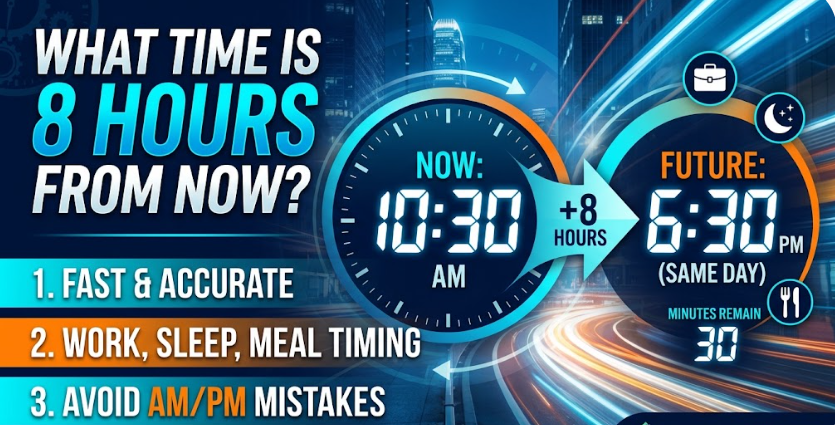
Whether you are tracking an 8-hour work shift, timing a long-haul flight, planning a full night of sleep, or scheduling an international meeting, finding out what time is 8 hours from now is one of the most frequent daily time-based searches.
Because time moves continuously, calculating 8 hours ahead requires a quick, dynamic addition to your current clock time. Below is a comprehensive breakdown, including quick-reference lookup tables, 12-hour vs. 24-hour conversion rules, and simple mental math shortcuts to avoid common AM/PM mistakes.
Quick Look-Up Chart: Current Time + 8 Hours
To quickly find what time it will be 8 hours from your current position without manual calculation, use this reference table:
| Current Time | Time 8 Hours From Now | Day Indicator |
| 12:00 AM (Midnight) | 8:00 AM | Same Day |
| 2:00 AM | 10:00 AM | Same Day |
| 4:00 AM | 12:00 PM (Noon) | Same Day |
| 6:00 AM | 2:00 PM | Same Day |
| 8:00 AM | 4:00 PM | Same Day |
| 10:00 AM | 6:00 PM | Same Day |
| 12:00 PM (Noon) | 8:00 PM | Same Day |
| 2:00 PM | 10:00 PM | Same Day |
| 4:00 PM | 12:00 AM (Midnight) | Next Day |
| 5:00 PM | 1:00 AM | Next Day |
| 8:00 PM | 4:00 AM | Next Day |
| 10:00 PM | 6:00 AM | Next Day |
How to Calculate 8 Hours From Now (Mental Math Tricks)
Adding eight hours manually is simple when you break it into step-by-step arithmetic. When adding pure hours, your minutes and seconds always remain identical to your starting time.
Method 1: The “Add 10, Subtract 2” Shortcut
If adding 8 feels awkward in your head, use the standard baseline trick: add 10 hours first, then subtract 2 hours.
- Example: Current time is 7:15 AM.
- Add 10 hours: $7:15 \text{ AM} + 10 \text{ hours} = 5:15 \text{ PM}$.
- Subtract 2 hours: $5:15 \text{ PM} – 2 \text{ hours} = \mathbf{3:15 \text{ PM}}$.
Method 2: The 24-Hour Military Format (Foolproof)
The 24-hour clock removes AM/PM confusion when crossing noon or midnight.
- Convert your start time to 24-hour time.
- Add 8 to the hour value.
- If the sum is 24 or greater, subtract 24 and advance to the next date.
$$\text{Future Hour} = (\text{Current Hour} + 8) \pmod{24}$$
- Example: Current time is 8:45 PM ($20:45$ in 24-hour time).$$20 + 8 = 28$$$$28 – 24 = 4 \quad (\text{Next Day})$$
- Result: 4:45 AM the next day.
Breakdown: 8 Hours in Different Time Units
Eight hours represents exactly one-third ($\frac{1}{3}$) of a standard 24-hour calendar day. Here is how 8 hours translates across precise measurements of time:
- Hours: $8 \text{ hours}$
- Minutes: $480 \text{ minutes}$ ($8 \times 60$)
- Seconds: $28,800 \text{ seconds}$ ($480 \times 60$)
- Milliseconds: $28,800,000 \text{ milliseconds}$
- Percentage of Day: $33.33\%$
Common Real-World Uses for 8-Hour Timers
An 8-hour duration is one of the most fundamental operational time blocks in human scheduling:
1. Standard Workplace Shifts
Most full-time labor contracts and corporate schedules base their full workday on an 8-hour block (e.g., 9:00 AM to 5:00 PM). Calculating 8 hours from your clock-in time tells you when your baseline working hours end.
2. Healthy Sleep Cycles
Health organizations generally recommend 7 to 9 hours of restorative sleep for adults. Calculating 8 hours from the time you go to bed gives you an ideal wake-up target for optimal circadian alignment.
3. Intermittent Fasting Windows
Popular health routines like the 16:8 Intermittent Fasting Method restrict eating to an 8-hour daily window. If your first meal is at 11:30 AM, adding 8 hours means your fasting window begins strictly at 7:30 PM.
4. Medication & Dosage Timers
Many common prescription medications, pain relievers, and antibiotics require doses administered every 8 hours (3 times daily). Accurate addition guarantees you do not take medications too early or too late.
Critical Pitfalls to Avoid in Time Addition
- Forgetting the Date Boundary: Any start time past 4:00 PM will automatically push your 8-hour destination into the following calendar day.
- Confusing AM and PM Labels: When passing 12:00 PM (Noon) or 12:00 AM (Midnight), ensure your standard 12-hour label flips correctly.
- Ignoring Time Zone Differences: If you are coordinating across regions (such as scheduling an international meeting between PST, EST, or PKT), calculating 8 hours from your local clock must account for the destination UTC/GMT offset.
Frequently Asked Questions (FAQ)
What time will it be 8 hours from 9:30 AM?
Eight hours from 9:30 AM is 5:30 PM on the same day.
What time is 8 hours after 4:00 PM?
Eight hours after 4:00 PM is 12:00 AM (Midnight), marking the start of the next calendar day.
How many minutes are in 8 hours?
There are exactly 480 minutes in 8 hours.
Does adding 8 hours change the minutes on my clock?
No. Because you are adding whole hours, the minute value stays exactly the same as your starting time.
Leave a Reply